Marble Vs Quartz – Which is Right for Your Kitchen?

Marble and quartz sit at opposite ends of the same story: one is quarried from the earth exactly as nature made it, the other is engineered in a factory to capture that same beauty without the drawbacks.
Both are among the most requested materials for kitchens and bathrooms, and both carry a genuine sense of luxury. So what actually separates marble from quartz? Are marble worktops still worth the extra care they demand, or has quartz worktop technology closed the gap? Here’s the honest breakdown to help you decide which is right for your home.
Natural Vs Engineered Stone
The fundamental difference between marble and quartz is where each material comes from. Marble is a 100% natural metamorphic stone, formed over millions of years as limestone is transformed by heat and pressure deep within the earth’s crust. Every slab is entirely unique, carrying its own veining, colour variation and character that simply cannot be replicated.
Quartz worktops, by contrast, are engineered. Manufacturers such as Caesarstone, Silestone and Compac take crushed natural quartz crystals, one of the hardest minerals on the planet, and bind them together with polymer resins and pigments, typically resulting in a slab that’s around 90-95% natural quartz. This engineering process means quartz can be manufactured to order in consistent colours and patterns, including designs that deliberately mimic the look of marble itself.
That last point is worth pausing on. A significant proportion of quartz sold today is designed specifically to imitate marble’s veining and soft colour palette. If you love the marble look but not the maintenance, this is exactly the compromise quartz was engineered to solve.
Marble and Quartz Comparison
Key differences between marble and quartz include:
| Feature | Marble | Quartz |
|---|---|---|
| Natural stone | 100% | 90-95% |
| Sealed | Sealing required, and needs resealing periodically | Never needs sealing |
| Heat resistant | Good, but prolonged direct heat can cause discolouration | Good, though quartz resin can scorch under very high heat |
| Stain resistant | Porous; sealing recommended and staining from acidic liquids is a real risk | Non-porous and highly stain resistant |
| Waterproof | Sealing recommended | Yes |
| Scratch and cut resistant | Softer stone; can scratch and chip more easily | Very good, one of the hardest worktop materials available |
| Etching resistant | No; acidic foods like lemon juice, wine and vinegar will etch the surface | Yes, quartz does not etch |
| Food safe | Sealing recommended | Yes |
| Available in tiles | Yes | Yes |
| Suitable for kitchen worktops | Yes, with care | Yes |
| Suitable for bathrooms | Yes | Yes |
| Suitable for outdoors | Not recommended; prone to weathering | Not recommended; UV exposure can fade resin over time |
| Looks like | Soft, organic veining, unique to every slab | Can replicate marble veining, or offer a clean, uniform finish |
| Easy to match? | Natural variation means slabs can vary, even from the same quarry | Consistent colour and pattern across batches |
| Most common colour | White and grey | White |
| Colours available | Whites, greys, blacks, and warmer tones depending on mineral content | Almost any colour, including consistent marble-effect designs |
| Lifespan with proper care | Decades, but requires ongoing maintenance | Decades, with minimal maintenance |
| Unusual features | Naturally cool to the touch, prized for baking | Doesn’t need sealing and resists everyday stains far better |
Appearance and Character
This is where marble has always had the edge, and probably always will. No two marble slabs are the same. The veining moves organically through the stone, and the subtle colour shifts, translucency and occasional fossil-like markings give a genuinely one-off surface that many homeowners feel engineered stone still can’t fully replicate. If you want a kitchen island or bathroom vanity that feels truly bespoke, marble delivers that in a way manufactured stone struggles to match.
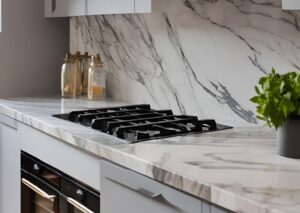
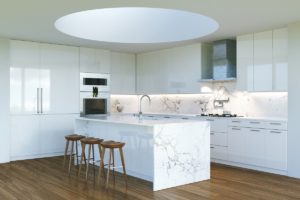
Quartz has closed the gap considerably in recent years, though. Modern quartz ranges use increasingly sophisticated printing and veining techniques to mimic Carrara, Calacatta and Marquina marbles convincingly, and because each slab is manufactured, you can order more of the exact same pattern if you ever need a repair, extension or matching piece elsewhere in the home. For larger kitchens where multiple slabs need to line up seamlessly, this consistency is a real practical advantage.
Maintenance and Everyday Practicality
This is the area where the two materials diverge most sharply, and it’s usually the deciding factor for most households.
Marble is porous. It needs sealing when installed, and typically needs resealing every 6 to 12 months to maintain its resistance to staining, depending on how the surface is used. Even when properly sealed, marble is vulnerable to etching, a dulling or discolouration of the surface caused by acidic substances like lemon juice, wine, vinegar and some cleaning products. Etching isn’t the same as staining and can’t simply be cleaned off; it changes the surface finish itself. For many people this is part of marble’s charm, a patina that tells the story of a well-used kitchen, but it isn’t for everyone.
Quartz asks far less of you. Because it’s non-porous, it never needs sealing, resists staining from everyday spills, and won’t etch when acidic liquids are left on the surface. For a busy family kitchen, a rental property, or anyone who simply doesn’t want to think about their worktop, quartz is the lower-maintenance option by a wide margin.
Durability and Heat Resistance
Quartz is harder and more resistant to scratching and chipping than marble, thanks to the concentration of natural quartz crystal in its makeup. Marble is a softer stone and, while still durable in everyday use, is more prone to scratching from knives and chipping from dropped pans, particularly at corners and edges.
Both materials handle moderate heat reasonably well, but neither should be treated as entirely heatproof. Marble can discolour under prolonged direct heat, while the resin content in quartz means it can scorch or discolour if a very hot pan is left directly on the surface for an extended period. A trivet is worth using with either material, though it becomes more of a habit than a strict necessity.
Cost Considerations
Pricing for both materials varies enormously depending on the specific stone or quartz range chosen, but as a general rule, marble tends to sit at the more expensive end of the natural stone market, reflecting its rarity, the complexity of quarrying large, unblemished slabs, and the skill required to fabricate it. Quartz pricing spans a much wider range, from more affordable entry-level ranges to premium designer collections that can rival or exceed the cost of marble.
It’s also worth factoring in the cost of ownership over time. Marble’s ongoing sealing and careful maintenance requirements add a small but recurring cost and time commitment that quartz simply doesn’t require.
Choosing Marble or Quartz
There isn’t a right answer here, only the right answer for how you live. If you want a surface with genuine natural character, a one-of-a-kind veining pattern, and you don’t mind resealing it periodically and treating it with a little more care, particularly around acidic foods and drinks, marble is hard to beat for sheer beauty and prestige. It remains one of the most desirable materials in interior design for good reason.
If your priority is a low-maintenance, hardwearing surface for a busy household, and you’d still like the elegance of a marble-inspired look without the upkeep, quartz is very likely the more practical choice. With today’s quartz ranges offering increasingly convincing marble-effect designs, many customers find they can get the aesthetic they want without compromising on day-to-day durability.
Both are excellent materials, and the right choice often comes down to how the space will actually be used. A statement bathroom vanity or a low-traffic feature island might be perfect for marble, while a family kitchen worktop that sees daily chopping, cooking and entertaining may be better served by quartz.
If you’re still weighing up your options, come and visit our showroom. Seeing and touching both materials side by side, in a range of colours and finishes, is by far the easiest way to make a confident decision.