Quartz and Sintered Stone Worktops – A Comparison

Quartz and sintered stone represent two of the most advanced, high-performance surface solutions available today. While both offer exceptional beauty, low maintenance, and supreme durability, they are built using fundamentally different processes and materials.
Quartz has long been the gold standard for luxury kitchen worktops, celebrated for its solid feel, vast design variety, and resilience against everyday family wear. Sintered stone, on the other hand, is the cutting edge of surface engineering, an ultra-compact material created under extreme pressure and heat to push the boundaries of scratch and thermal resistance.
So, what actually separates quartz from sintered stone? Does sintered stone render quartz obsolete, or does quartz still hold the crown for practical everyday living? Here is the honest breakdown from our team at Surrey Marble & Granite to help you decide which material is right for your home.
Engineered Composite Vs Sintered Tech
The primary distinction between quartz and sintered stone lies in their composition and manufacturing process.
Quartz worktops are an engineered stone composite. They are crafted by combining 90–95% natural crushed quartz crystals, one of nature’s hardest minerals, with high-grade polymer resins and colour pigments. The mixture is compacted under vacuum and vibration, then cured into solid, non-porous slabs. The inclusion of resin gives quartz a touch of flexibility, making it exceptionally tough and impact-resistant under heavy domestic use.
Sintered stone (manufactured by leading brands such as Neolith, Dekton, and Lapitec) undergoes a process called ‘sintering’. Natural raw minerals, similar to those found in granite and porcelain, including quartz, feldspar, glass, and clay, are subjected to thousands of tonnes of pressure and then fused at temperatures exceeding 1200°C. Rather than using resins to bind the particles, the extreme heat and pressure bond the minerals together at a molecular level, creating a virtually indestructible, ultra-dense slab.
Because quartz relies on resins to hold its structure, it behaves differently under direct heat and UV exposure when compared to the fully mineralised structure of sintered stone.
Quartz and Sintered Stone Comparison
Key differences between quartz and sintered stone include:
| Feature | Quartz | Sintered Stone |
|---|---|---|
| Composition | 90–95% quartz crystals bound with polymer resin | 100% natural minerals fused under extreme heat/pressure |
| Sealing | Never needs sealing | Never needs sealing |
| Heat Resistance | Good, but resin can scorch under direct thermal shock | Exceptional; completely unaffected by hot pans or flames |
| Stain Resistance | Non-porous and highly stain resistant | Completely non-porous and impervious to stains/chemicals |
| UV / Outdoor Use | Not recommended; sunlight degrades resin over time | Fully UV-stable; will not fade or discolour outdoors |
| Scratch Resistance | Very good; highly resistant to everyday kitchen wear | Extreme; virtually unscratchable by kitchen tools |
| Impact / Chipping | Superior impact resistance; absorbs knocks very well | Highly rigid; sharp impacts on exposed edges can cause chipping |
| Thickness Options | Typically 20mm or 30mm for a substantial, traditional profile | Typically 6mm, 12mm, or 20mm for sleek, modern profiles |
| Lifespan | Decades with minimal maintenance | Decades with zero degradation |
Appearance and Design Flexibility
Both materials offer stunning visual versatility, but they create different design statements in a kitchen or bathroom.
Quartz provides a substantial, solid presence. Because its patterns and crushed mineral particles are mixed throughout the resin matrix, the colour and veining are consistent through the entire thickness of the slab. This makes edge profiling, drainage grooves, and exposed cutouts seamless and straightforward. Quartz is available in hundreds of styles, from clean, polished whites to subtle marble-effect veining and concrete textures.
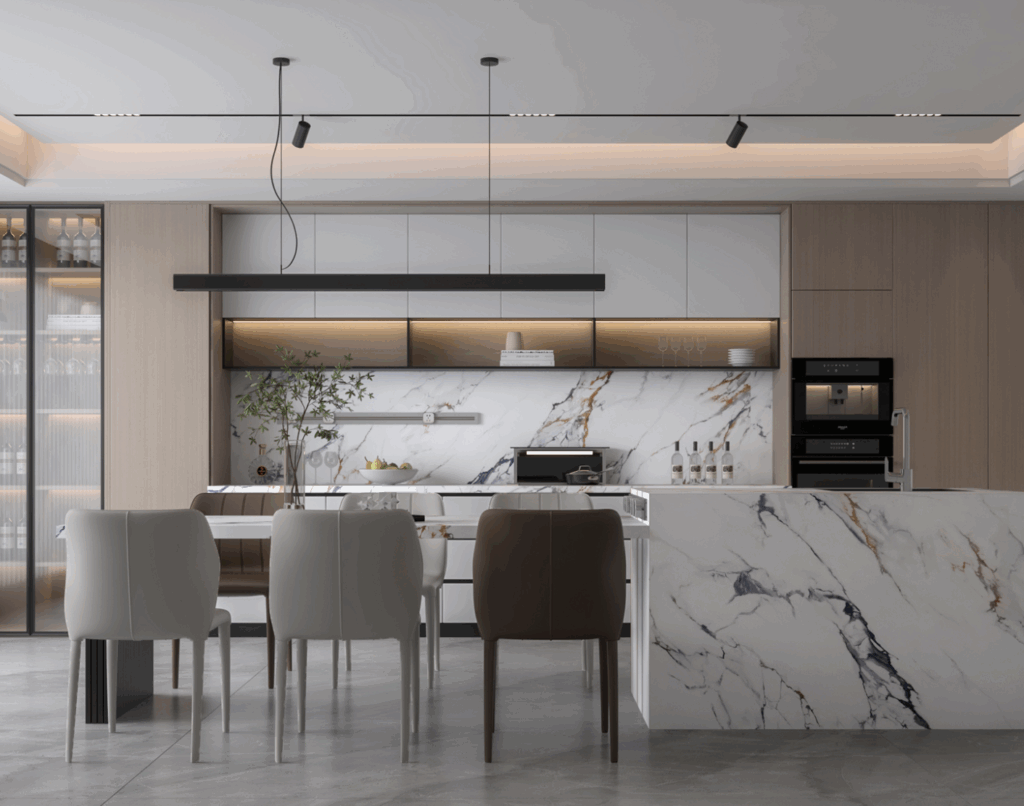
Sintered stone is renowned for its ultra-high-definition surface rendering. Complex marble veins, industrial metals, timber grains, and natural slate textures can be printed onto the surface with incredible precision. Sintered stone is also available in much thinner slab profiles (starting from as little as 6mm or 12mm), making it ideal for sleek, contemporary handleless kitchens, wall cladding, and integrated sink basins. While full-body veining is becoming more advanced in sintered stone, intricate marble patterns are often concentrated on the top layer, requiring expert mitred joint fabrication for thick-edge illusions.
Maintenance and Everyday Practicality
In terms of routine hygiene and cleaning, both surfaces are virtually effortless to live with. Neither quartz nor sintered stone is porous, meaning neither material will harbour bacteria, absorb liquids, or require periodic sealing like natural marble or granite. Spills of red wine, coffee, lemon juice, and olive oil wipe away cleanly with simple warm water and soap.
Where sintered stone takes a clear lead is in harsh environmental conditions. Sintered stone is completely immune to UV radiation, meaning its colour will never yellow, fade, or break down under direct sunlight. This makes it the premier choice for outdoor kitchens, patio dining areas, and sun-drenched garden rooms where quartz cannot be safely installed.
Durability and Heat Resistance
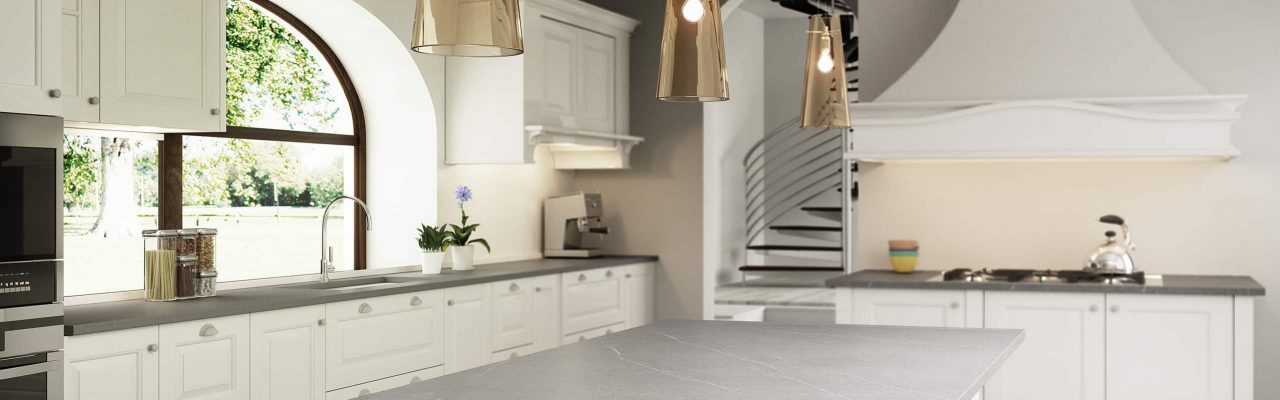
How you use your kitchen on a day-to-day basis will likely dictate which of these two surfaces is best suited to your household.
Sintered Stone Durability: Sintered stone is as close to indestructible against heat and scratching as a surface can get. Because it was born in a 1200°C kiln, hot roasting tins and pans can be placed directly from the oven onto the surface without trivets. You can also cut ingredients straight onto the stone without scratching it (though your chef’s knives may suffer). However, because the material is so dense and rigid, its edges are slightly more susceptible to chipping if struck hard by a heavy object, such as a cast-iron pan.
Quartz Durability: Quartz cannot withstand direct, extreme thermal shock. Placing a burning-hot pan directly onto quartz can melt or discolour the internal resins, leaving permanent scorch rings; trivets are always recommended. However, that same resin binder gives quartz superior tensile strength and flexibility. Quartz is exceptionally forgiving against heavy domestic impacts, easily handling the bumps, knocks, and accidental drops of a busy family home.
Cost Considerations
At a raw material level, high-end quartz and premium sintered stone occupy a similar price bracket. However, fabrication and installation costs for sintered stone are generally higher. Because sintered stone is extremely hard and brittle prior to installation, it requires specialised diamond-tooled machinery, precise waterjet cutting, and highly experienced stonemasons to fabricate cleanly. Quartz, while still requiring professional stonemasonry, is slightly easier to cut and finish on site.
Choosing Quartz or Sintered Stone
Ultimately, the best choice depends on your design aesthetic, intended usage, and lifestyle requirements.
Choose Sintered Stone if: You are seeking an ultra-slim modern design profile, want the absolute freedom to place boiling-hot cookware directly onto your worktop, or are building an outdoor kitchen space that requires complete UV protection.
Choose Quartz if: You prefer a thick, classic worktop profile (20mm or 30mm) with through-body veining, value maximum impact resistance against family life bumps, and want a timeless material with a proven track record across thousands of homes.
Need expert advice on choosing the perfect worktop for your kitchen project? Contact the team at Surrey Marble & Granite today or visit our showroom to view large-scale samples of both quartz and sintered stone.